 Add to Chrome
 Add to Firefox
 Add to Edge
MotionMERGE: A Multi-granular Framework for Human Motion Editing, Reasoning, Generation, and Explanation
May 18, 2026
Recent motion-language models unify tasks like comprehension and generation but operate at a coarse granularity, lacking fine-grained understanding and nuanced control over body parts needed for animation or interaction. This stems from fundamental issues in both the model and the data, in which the model can't focus on motion's localized pattern, and the training data lacks fine-grained supervision. To tackle this, we propose MotionMERGE, a unified framework that bridges the granularity gap. First, we pioneer the study of fine-grained languageguided motion control, including detailed understanding and localized editing, by explicitly modeling motion at part and temporal levels within a single LLM, thereby endowing the model with robust priors for precise control. Second, we design ReasoningAware Granularity-Synergy pre-training, a novel strategy that employs joint supervision for cross-granularity alignment, temporal grounding, localized alignment, motion coherency, and motion-grounded chain-of-thought (CoT) reasoning. This equips the model with fine-grained motion-language alignment, crossgranularity synergy, and explicit reasoning ability. Third, we curate MotionFineEdit, a large-scale dataset (837K atomic + 144K complex triplets) with the first fine-grained spatio-temporal corrective instructions and motion-grounded CoT annotations, establishing a new benchmark for fine-grained text-driven motion editing and motion-grounded reasoning. Extensive experiments demonstrate the capability of MotionMERGE for more precise motion generation, understanding, and editing, and compelling zero-shot generalization to other complex motion tasks. This work represents a significant step toward models that interact with motion in finer granularity and human-like reasoning.

AIM-Bench: Benchmarking and Improving Affective Image Manipulation via Fine-Grained Hierarchical Control
Apr 12, 2026Affective Image Manipulation (AIM) aims to evoke specific emotions through targeted editing. Current image editing benchmarks primarily focus on object-level modifications in general scenarios, lacking the fine-grained granularity to capture affective dimensions. To bridge this gap, we introduce the first benchmark designed for AIM termed AIM-Bench. This benchmark is built upon a dual-path affective modeling scheme that integrates the Mikels emotion taxonomy with the Valence-Arousal-Dominance framework, enabling high-level semantic and fine-grained continuous manipulation. Through a hierarchical human-in-the-loop workflow, we finally curate 800 high-quality samples covering 8 emotional categories and 5 editing types. To effectively assess performance, we also design a composite evaluation suite combining rule-based and model-based metrics to holistically assess instruction consistency, aesthetics, and emotional expressiveness. Extensive evaluations reveal that current editing models face significant challenges, most notably a prevalent positivity bias, which stemming from inherent imbalances in training data distribution. To tackle this, we propose a scalable data engine utilizing an inverse repainting strategy to construct AIM-40k, a balanced instruction-tuning dataset comprising 40k samples. Concretely, we enhance raw affective images via generative redrawing to establish high-fidelity ground truths, and synthesize input images with divergent emotions and paired precise instructions. Fine-tuning a baseline model on AIM-40k yields a 9.15% relative improvement in overall performance, demonstrating the effectiveness of our AIM-40k. Our data and related code will be made open soon.
FED-Bench: A Cross-Granular Benchmark for Disentangled Evaluation of Facial Expression Editing
Mar 31, 2026Facial expression image editing requires fine-grained control to strictly preserve human identity and background while precisely manipulating expression. However, existing editing benchmarks primarily focus on general scenarios, lacking high-quality facial images and corresponding editing instructions. Furthermore, current evaluation metrics exhibit systemic biases in this task, often favoring lazy editing or overfit editing. To bridge these gaps, we propose FED-Bench, a comprehensive benchmark featuring rigorous testing and an accurate evaluation suite. First, we carefully construct a benchmark of 747 triplets through a cascaded and scalable pipeline, each comprising an original image, an editing instruction, and a ground-truth image for precise evaluation. Second, we introduce FED-Score, a cross-granularity evaluation protocol that disentangles assessment into three dimensions: Alignment for verifying instruction following, Fidelity for testing image quality and identity preservation, and Relative Expression Gain for quantifying the magnitude of expression changes, effectively mitigating the aforementioned evaluation biases. Third, we benchmark 18 image editing models, revealing that current approaches struggle to simultaneously achieve high fidelity and accurate expression manipulation, with fine-grained instruction following identified as the primary bottleneck. Finally, leveraging the scalable characteristic of introduced benchmark engine, we provide a 20k+ in-the-wild facial training set and demonstrate its effectiveness by fine-tuning a baseline model that achieves significant performance gains. Our benchmark and related code will be made publicly open soon.
X-ray Insights Unleashed: Pioneering the Enhancement of Multi-Label Long-Tail Data
Dec 24, 2025Long-tailed pulmonary anomalies in chest radiography present formidable diagnostic challenges. Despite the recent strides in diffusion-based methods for enhancing the representation of tailed lesions, the paucity of rare lesion exemplars curtails the generative capabilities of these approaches, thereby leaving the diagnostic precision less than optimal. In this paper, we propose a novel data synthesis pipeline designed to augment tail lesions utilizing a copious supply of conventional normal X-rays. Specifically, a sufficient quantity of normal samples is amassed to train a diffusion model capable of generating normal X-ray images. This pre-trained diffusion model is subsequently utilized to inpaint the head lesions present in the diseased X-rays, thereby preserving the tail classes as augmented training data. Additionally, we propose the integration of a Large Language Model Knowledge Guidance (LKG) module alongside a Progressive Incremental Learning (PIL) strategy to stabilize the inpainting fine-tuning process. Comprehensive evaluations conducted on the public lung datasets MIMIC and CheXpert demonstrate that the proposed method sets a new benchmark in performance.
Show-o2: Improved Native Unified Multimodal Models
Jun 18, 2025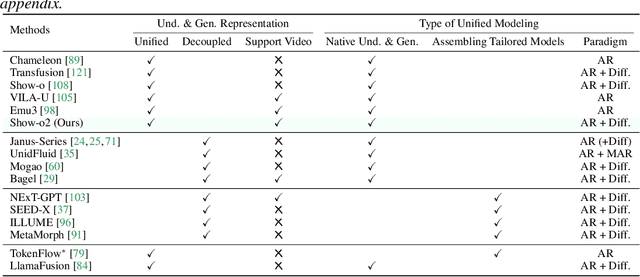
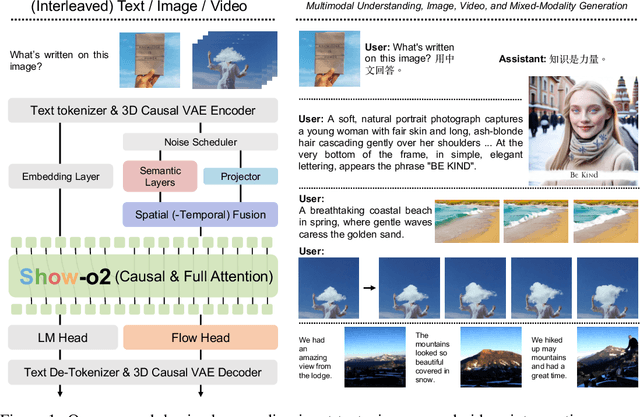
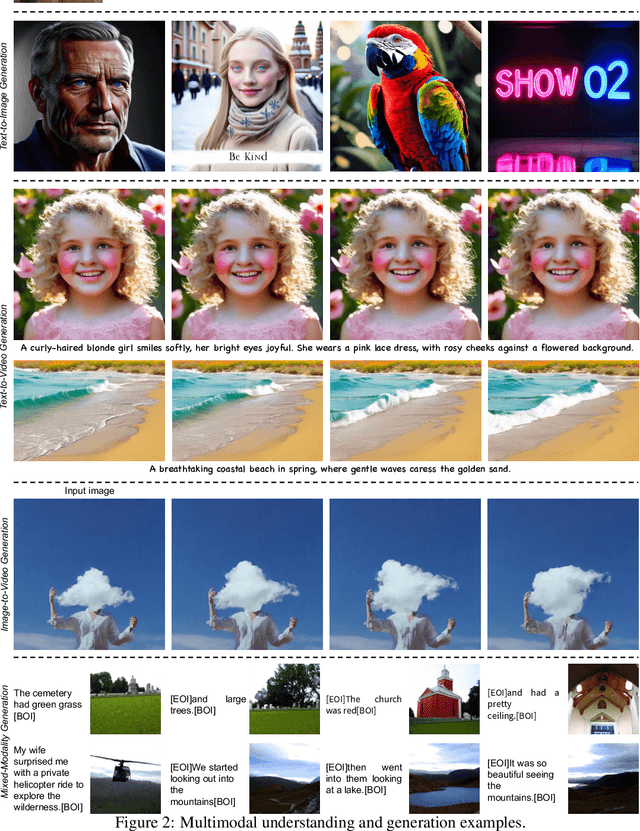
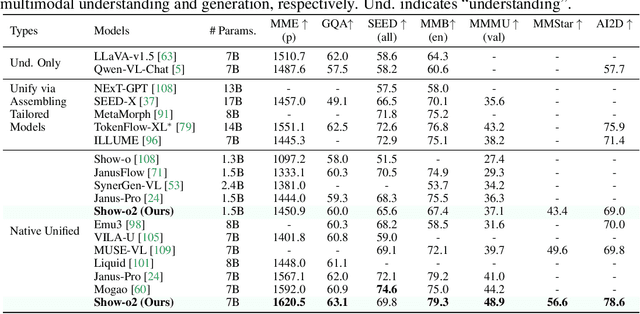
This paper presents improved native unified multimodal models, \emph{i.e.,} Show-o2, that leverage autoregressive modeling and flow matching. Built upon a 3D causal variational autoencoder space, unified visual representations are constructed through a dual-path of spatial (-temporal) fusion, enabling scalability across image and video modalities while ensuring effective multimodal understanding and generation. Based on a language model, autoregressive modeling and flow matching are natively applied to the language head and flow head, respectively, to facilitate text token prediction and image/video generation. A two-stage training recipe is designed to effectively learn and scale to larger models. The resulting Show-o2 models demonstrate versatility in handling a wide range of multimodal understanding and generation tasks across diverse modalities, including text, images, and videos. Code and models are released at https://github.com/showlab/Show-o.
MG-MotionLLM: A Unified Framework for Motion Comprehension and Generation across Multiple Granularities
Apr 03, 2025Recent motion-aware large language models have demonstrated promising potential in unifying motion comprehension and generation. However, existing approaches primarily focus on coarse-grained motion-text modeling, where text describes the overall semantics of an entire motion sequence in just a few words. This limits their ability to handle fine-grained motion-relevant tasks, such as understanding and controlling the movements of specific body parts. To overcome this limitation, we pioneer MG-MotionLLM, a unified motion-language model for multi-granular motion comprehension and generation. We further introduce a comprehensive multi-granularity training scheme by incorporating a set of novel auxiliary tasks, such as localizing temporal boundaries of motion segments via detailed text as well as motion detailed captioning, to facilitate mutual reinforcement for motion-text modeling across various levels of granularity. Extensive experiments show that our MG-MotionLLM achieves superior performance on classical text-to-motion and motion-to-text tasks, and exhibits potential in novel fine-grained motion comprehension and editing tasks. Project page: CVI-SZU/MG-MotionLLM
Show-o: One Single Transformer to Unify Multimodal Understanding and Generation
Aug 22, 2024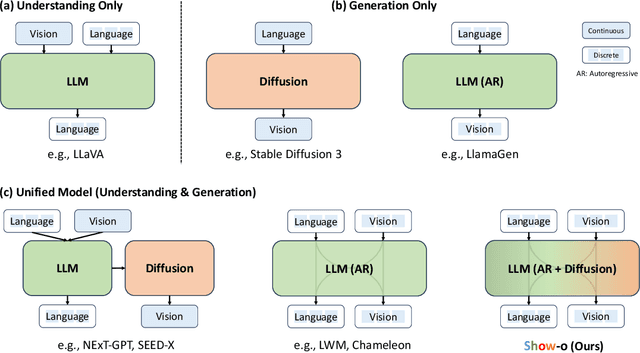

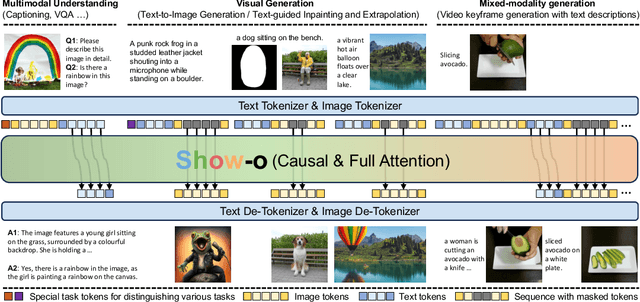

We present a unified transformer, i.e., Show-o, that unifies multimodal understanding and generation. Unlike fully autoregressive models, Show-o unifies autoregressive and (discrete) diffusion modeling to adaptively handle inputs and outputs of various and mixed modalities. The unified model flexibly supports a wide range of vision-language tasks including visual question-answering, text-to-image generation, text-guided inpainting/extrapolation, and mixed-modality generation. Across various benchmarks, it demonstrates comparable or superior performance to existing individual models with an equivalent or larger number of parameters tailored for understanding or generation. This significantly highlights its potential as a next-generation foundation model. Code and models are released at https://github.com/showlab/Show-o.
Learning Video Context as Interleaved Multimodal Sequences
Jul 31, 2024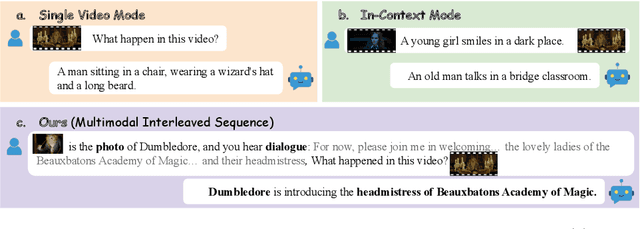

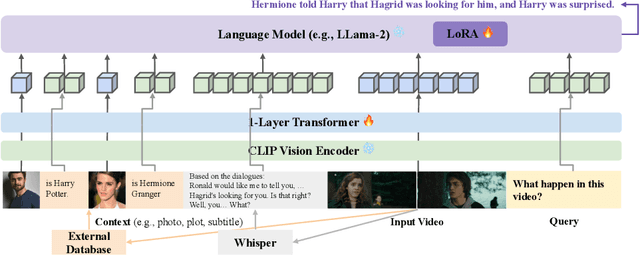

Narrative videos, such as movies, pose significant challenges in video understanding due to their rich contexts (characters, dialogues, storylines) and diverse demands (identify who, relationship, and reason). In this paper, we introduce MovieSeq, a multimodal language model developed to address the wide range of challenges in understanding video contexts. Our core idea is to represent videos as interleaved multimodal sequences (including images, plots, videos, and subtitles), either by linking external knowledge databases or using offline models (such as whisper for subtitles). Through instruction-tuning, this approach empowers the language model to interact with videos using interleaved multimodal instructions. For example, instead of solely relying on video as input, we jointly provide character photos alongside their names and dialogues, allowing the model to associate these elements and generate more comprehensive responses. To demonstrate its effectiveness, we validate MovieSeq's performance on six datasets (LVU, MAD, Movienet, CMD, TVC, MovieQA) across five settings (video classification, audio description, video-text retrieval, video captioning, and video question-answering). The code will be public at https://github.com/showlab/MovieSeq.
WMAdapter: Adding WaterMark Control to Latent Diffusion Models
Jun 12, 2024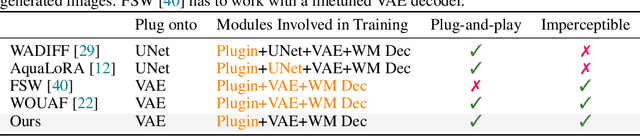
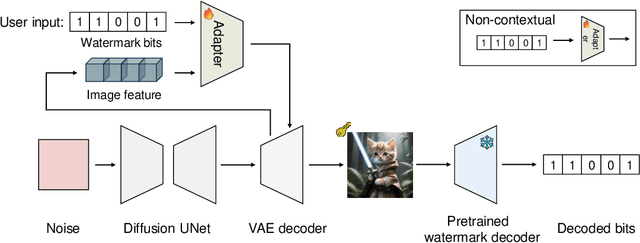

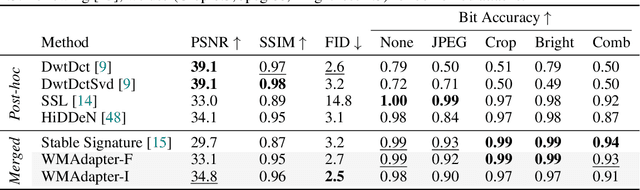
Watermarking is crucial for protecting the copyright of AI-generated images. We propose WMAdapter, a diffusion model watermark plugin that takes user-specified watermark information and allows for seamless watermark imprinting during the diffusion generation process. WMAdapter is efficient and robust, with a strong emphasis on high generation quality. To achieve this, we make two key designs: (1) We develop a contextual adapter structure that is lightweight and enables effective knowledge transfer from heavily pretrained post-hoc watermarking models. (2) We introduce an extra finetuning step and design a hybrid finetuning strategy to further improve image quality and eliminate tiny artifacts. Empirical results demonstrate that WMAdapter offers strong flexibility, exceptional image generation quality and competitive watermark robustness.
Learning Long-form Video Prior via Generative Pre-Training
Apr 24, 2024
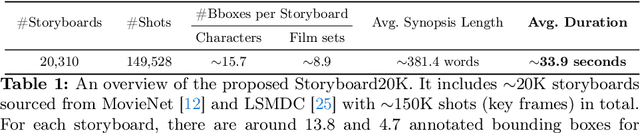


Concepts involved in long-form videos such as people, objects, and their interactions, can be viewed as following an implicit prior. They are notably complex and continue to pose challenges to be comprehensively learned. In recent years, generative pre-training (GPT) has exhibited versatile capacities in modeling any kind of text content even visual locations. Can this manner work for learning long-form video prior? Instead of operating on pixel space, it is efficient to employ visual locations like bounding boxes and keypoints to represent key information in videos, which can be simply discretized and then tokenized for consumption by GPT. Due to the scarcity of suitable data, we create a new dataset called \textbf{Storyboard20K} from movies to serve as a representative. It includes synopses, shot-by-shot keyframes, and fine-grained annotations of film sets and characters with consistent IDs, bounding boxes, and whole body keypoints. In this way, long-form videos can be represented by a set of tokens and be learned via generative pre-training. Experimental results validate that our approach has great potential for learning long-form video prior. Code and data will be released at \url{https://github.com/showlab/Long-form-Video-Prior}.